Are you living alone?
In need of Respite Care help?
Facing Caregiver burnout?
Take this short online test to find out where you fall on the UCLA loneliness scale.
The Problem
Loneliness - and not being understood
American society rests on an assumption that families take care of their own. But 15 million Americans 50 and older didn’t have any close family — spouses, partners, or children — in 2015, the latest year for which reliable estimates are available. Most lived alone.
There are 12 million adults in the U.S. living without a spouse or partner. Many are single by choice, others are widowed, or divorced. They may be childless or, not in touch with their children or other family members. Consider the Gen Silent LGBTQ community. By 2060, that number is expected to swell to 21 million.
Beyond that, millions of seniors living alone aren’t geographically close to adult children or other family members. Or they have difficult, strained relationships that keep them from asking for support.
Among elders older than 75, loneliness happens by way of;
- Aging in Place - 44% are women living alone.
- Living in Institutions - 61% of older people living in care homes are moderately lonely. 35% are severely lonely; most live in depression. 1, 2
- Estrangement - 27% of families in the U.S. live closed off from one another.
Moreover, according to a study published by the National Academies of Sciences, Engineering, and Medicine in 2020, as many as 43 percent of all adults aged sixty and older in the United States report feeling lonely—and these are the pre-pandemic numbers.
The Solution
Affordable Caregivers from Afar, aided with AI assistants

The Experience
Just open the map and touch a person's face to engage. Works like an UberCARE for care workers. Intervieiw and then activate a caregiver from afar. Filter the map by name, age, gender, language, ratings, hourly ratre and more.


Have fun working with AI Assistants
Next let Caregiver's superpowers shine by joining their Agentic AI templates to data in your Family Circle Vault.
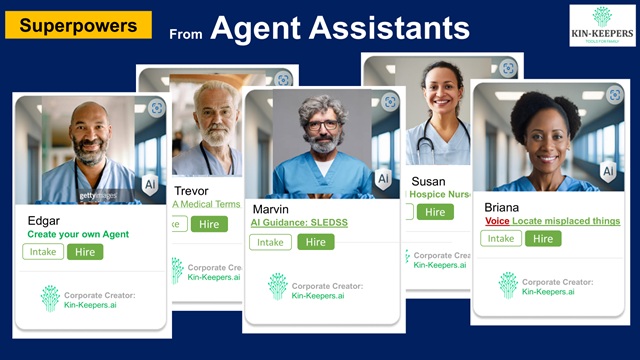

Animated with a Powerful AI Family Circle Desktop Application
We give you a free Small Language Model that runs on a home laptop, a Table or a Phone. It also provides information to Smart Glasses. Not connected to the cloud. The tool runs disconnected from the Internet.
The applicatoin runs in two modes: Chatbot (in any language) or AI Services. Both work with touch text or voice.
How it Works
People with Mild Cognitive Impairment or of dementia struggle to be undertood. While engaged with our tools, the voice of the elder is used to develop a Digital Twin, which serves as a Cognitive Prosthetic. It facilitates words and understanding between elders and caregivers.

The number of people ages 65 and older in the United States has increased steadily during the past century. Growth has accelerated since 2011 when baby boomers first started to turn 65. Between 2020 and 2060, the number of older adults is projected to increase by 69 percent, from 56.0 million to 94.7 million. The number of people ages 85 and older is projected to nearly triple from 6.7 million in 2020 to 19.0 million by 2060.
There's more. In 2020, for the first time in human history, elderlies outnumbered children. The number is projected to grow by 40% before 2030 up to 1.4 Billion. Among them, many are living lonely far away from their children, and are suffering from a shortage of healthcare professionals.
Join the Waitlist
Down load our UberCARE like application to apply to be a remote caregiver and start making money from home.
https://remotecarers.net/worker/